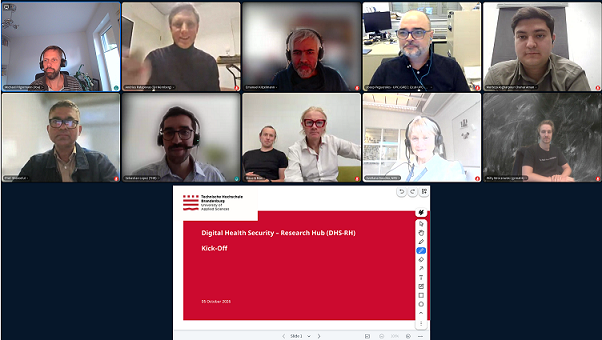
Work on the new “Digital Health Security Research Hub” (DHS-RH) research project at Brandenburg University of Applied Sciences (THB) officially began on Monday with a virtual kick-off meeting. Funded by the German Federal Ministry of Research, Technology, and Space (BMFTR), the project brings together leading European stakeholders to strengthen cybersecurity in the healthcare sector through intensive knowledge exchange. The goal is to use AI to effectively protect critical infrastructure, such as hospitals, from cyberattacks. Under the leadership of Prof. Dr. Michael Pilgermann, the THB is collaborating closely with the Technical Universities of Ingolstadt and Nuremberg, as well as with international partners from countries including Greece, Norway, the United Kingdom, and Spain.
Hospitals and medical facilities are considered critical infrastructure and are increasingly being targeted by cybercriminals. To strategically address this threat at the European level, the DHS-RH project was launched on September 15, 2026. The one-year project is funded by BMFTR as part of the “HAW-EuropaNetzwerke” program. At the recent kick-off meeting, the participating stakeholders laid out the operational roadmap.
The project is led by THB Professor Michael Pilgermann, who has been heading the “MedSec – IT Security in Healthcare” research group at the Brandenburg University of Applied Sciences since 2021. Key partners at the national level include the Technical University of Ingolstadt, represented by Prof. Patrizia Heinl, and the Technical University of Nuremberg, represented by Prof. Dr. Andrius Patapovas. A close and successful collaboration has existed for several years between these institutions and THB through the Working Group on Digital Security in Healthcare of the German Informatics Society (GI), and this collaboration is now being expanded internationally.
A Platform for Europe’s Cybersecurity in Healthcare
The central goal of the DHS-RH is to integrate scientific activities and applied research in the field of AI-driven healthcare cybersecurity across Europe. Since current research in this area has so far mostly taken place in isolation, the growing threat landscape requires a systematic pooling of resources and knowledge. The hub serves as a central point of contact for networking researchers and industry partners, as well as a platform for the continuous exchange of knowledge and methodologies.
“The cyber threat situation does not stop at national borders, not even for healthcare facilities. With the Digital Health Security Research Hub, we are creating a sustainable platform that brings together European expertise and makes it accessible to practitioners. We are actively involving experts and incorporating findings from ongoing and past research projects to avoid reinventing the wheel. Beyond academia and industry, we also warmly invite policymakers at the EU level to participate and collaborate. In this way, we are enabling a comprehensive view of the challenges and potential solutions for secure digital health infrastructures,” emphasizes project manager Michael Pilgermann.
The network established in this way is intended to remain active beyond the project’s duration and create sustainable synergies. A stated goal is to build a powerful consortium within the network to apply for further EU funding. This will ensure that European cybersecurity in the healthcare sector is permanently strengthened in the future as well.
Further information and contact:
- Official website: For more information about the project, visit www.dhs-rh.eu
- Contact: If you have any questions, please contact us by email at
dhs-rh(at)th-brandenburg.de .